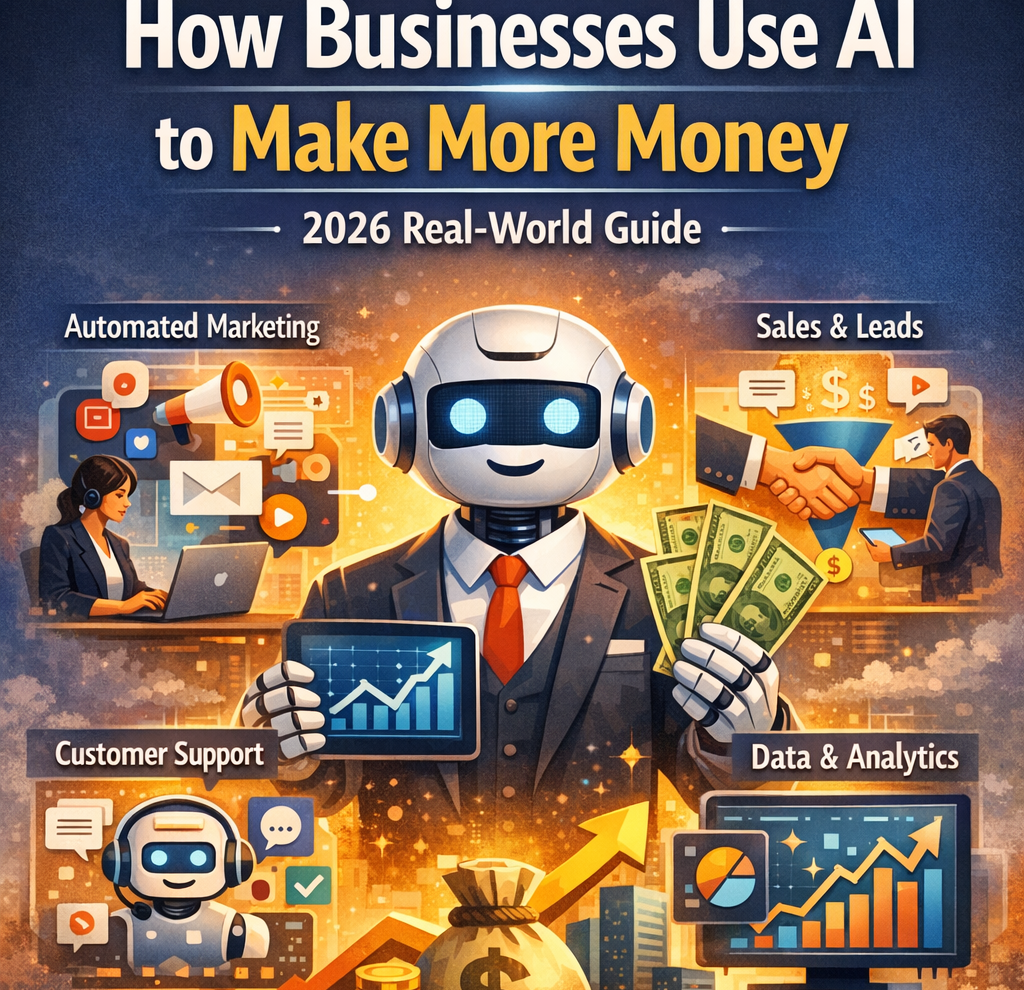
How Businesses Are Using AI to Make More Money in 2026
In 2026, businesses are no longer asking:
“What is AI?”
Now they are asking:
“How can AI help me make more money?”
That shift is important.
Because the businesses winning with AI are not always the biggest ones.
They are usually the ones using AI in practical, profit-focused ways.
Some are using it to:
- reply to leads faster
- automate follow-ups
- write better marketing content
- reduce support workload
- improve sales conversion
- save team time
- personalize customer experience
- make smarter decisions using data
In other words:
AI is not only saving time — it is helping businesses increase revenue.
That is why so many companies are taking it seriously.
Recent business research from PwC found that industries most exposed to AI saw 3x higher growth in revenue per employee compared with the least exposed industries, and productivity growth accelerated sharply after generative AI adoption.
But there is one important truth most people miss:
Businesses do not make more money from AI just by “using AI.”
They make more money when AI is connected to a real business bottleneck.
That means:
- slow lead response
- poor follow-up
- weak content
- manual admin work
- customer support delays
- low conversion rates
- inconsistent marketing
- wasted team hours
This guide will show you how businesses are actually using AI to make more money in 2026, with:
- real-world use cases
- beginner-friendly explanations
- small business examples
- practical automation ideas
- step-by-step guidance
- SEO-safe, AdSense-safe, people-first advice
If you run a business, freelance service, agency, local brand, online store, or content-based business, this article will help you understand where AI actually creates revenue.
Why Businesses Are Investing in AI in 2026
Most businesses do not buy tools because they are “trendy.”
They invest when there is a chance of getting one of these three outcomes:
1. More sales
2. Lower costs
3. Faster operations
AI helps with all three — if used correctly.
That is why adoption is growing across both large companies and smaller businesses.
For example, Meta launched a new small-business-focused initiative in March 2026 built around helping businesses use AI across Facebook, Instagram, and WhatsApp, reflecting how central AI has become for marketing and customer communication.
At the same time, research from PwC shows companies using AI are seeing measurable gains in productivity, and in many cases, better output per employee.
That matters because in business:
Higher productivity often means higher profit — if the saved time gets redirected into sales, service, and growth.
The Biggest Mistake Businesses Make With AI
Before we talk about what works, let’s clear one thing up:
The biggest mistake is using AI everywhere without a business goal.
A lot of businesses say:
- “Let’s use AI for content”
- “Let’s add a chatbot”
- “Let’s automate everything”
But that approach usually creates noise, not results.
The better approach is:
Find the biggest business bottleneck first. Then use AI there.
That bottleneck is usually one of these:
- not enough leads
- poor follow-up
- slow sales process
- too much admin work
- weak marketing consistency
- low conversion rate
- customer service overload
Once AI is plugged into one of those areas, the chance of revenue impact becomes much higher.
This is also what you see repeatedly in community discussions: people report the best outcomes when AI is tied directly to conversion, sales, or customer response, not just surface-level “smartness.”
How Businesses Are Actually Using AI to Make More Money in 2026
Now let’s get practical.
Below are the most useful real-world ways businesses are using AI to increase revenue.
1) AI for Faster Lead Response and More Conversions
One of the fastest ways AI helps businesses make more money is by helping them respond to leads faster.
This matters because many businesses lose sales not because their offer is bad — but because they reply too late.
If someone:
- fills a form
- sends a DM
- asks for pricing
- requests a callback
- messages on WhatsApp
- submits an inquiry
and nobody responds quickly, that lead often goes cold.
How AI helps
AI can help by:
- answering common questions instantly
- qualifying leads
- sending automated replies
- booking calls
- collecting customer details
- routing high-intent inquiries
Real-world example
Imagine a local salon, clinic, coaching business, or web design service.
Every day they get messages like:
- “What are your prices?”
- “Do you have availability?”
- “How do I book?”
- “Can you send package details?”
Instead of waiting hours to reply manually, AI can respond instantly with:
- package information
- booking links
- FAQs
- next steps
That means:
- more replies
- less drop-off
- more booked conversations
- more closed sales
Why this increases revenue
Because speed closes deals.
If your business responds in 1 minute instead of 6 hours, your conversion chance usually improves.
This is one of the highest ROI use cases for small businesses.
2) AI for Sales Follow-Up That Actually Happens
A lot of businesses do not lose money because they fail to get leads.
They lose money because they fail to follow up.
And this happens constantly.
Someone shows interest.
Someone asks for pricing.
Someone says “I’ll think about it.”
Someone abandons the conversation.
Then nothing happens.
That is lost revenue.
How AI helps
AI can support:
- follow-up email sequences
- WhatsApp reminders
- quote follow-ups
- proposal reminders
- abandoned inquiry follow-ups
- sales message drafting
Real-world example
Suppose you run a:
- digital service
- coaching offer
- home service business
- local product business
- ecommerce store
A customer asks about your service but does not buy immediately.
AI can trigger:
- a reminder message
- a testimonial-based follow-up
- a “still interested?” check-in
- a limited-time offer follow-up
This helps revive leads that would otherwise disappear.
Why this makes money
Because follow-up is where many businesses quietly leak revenue.
And AI helps plug that leak.
3) AI for Better Marketing Content That Brings More Customers
Most businesses know they should market more.
The problem is consistency.
They often struggle with:
- what to post
- how to write it
- how to make visuals
- how to stay regular
- how to create content without hiring a full team
That is why AI content tools have become so useful.
How AI helps
Businesses now use AI to create:
- blog outlines
- ad copy
- email campaigns
- product descriptions
- social media captions
- video scripts
- website headlines
- landing page copy
Real-world example
Imagine a clothing shop, bakery, clinic, or home decor business.
Instead of posting randomly, they can use AI to create:
- 30 days of Instagram content ideas
- weekly promotional captions
- festival offer creatives
- email promo campaigns
- customer education posts
That means the business stays visible more consistently.
And visibility usually improves:
- trust
- reach
- inquiries
- repeat visits
- sales opportunities
Important point
AI content only works if it is:
- edited
- relevant
- humanized
- useful
Generic spam content does not help much.
But well-edited, targeted AI-assisted content can support real growth.
4) AI for Customer Support Without Hiring More Staff
Another major business use case in 2026 is AI-powered customer support.
Support work often includes repetitive questions like:
- where is my order?
- what are your prices?
- how do I book?
- what is your return policy?
- do you offer this service?
- what are your timings?
When a team keeps answering the same questions again and again, it slows down growth.
How AI helps
AI can handle:
- FAQs
- order status guidance
- booking information
- refund/return basics
- common product questions
- appointment support
Real-world example
Let’s say you run an online store.
Customers keep asking:
- “Is this available?”
- “How many days for delivery?”
- “Can I exchange it?”
- “Which size should I buy?”
AI support can answer instantly and escalate only complex cases to humans.
Why this makes money
Because it improves:
- customer satisfaction
- reply speed
- buyer confidence
- team efficiency
And that often leads to:
- fewer abandoned customers
- more completed purchases
- better repeat business
5) AI for Ecommerce Product Pages That Sell Better
Ecommerce businesses are using AI heavily because every product page, ad, and description affects sales.
Even small improvements in:
- titles
- descriptions
- images
- FAQs
- product recommendations
- customer messaging
can increase conversions.
How AI helps ecommerce
AI can support:
- SEO-friendly product descriptions
- feature-to-benefit writing
- ad creative variations
- review summarization
- FAQ generation
- email upsell sequences
- cart recovery messaging
Real-world example
Imagine an online store selling:
- kids clothing
- beauty products
- accessories
- home decor
- gadgets
Instead of writing weak product descriptions like:
“Good quality cotton shirt for kids”
AI can help create stronger copy like:
“Soft breathable cotton kids shirt designed for all-day comfort, easy movement, and everyday wear.”
That sounds more customer-focused and sales-friendly.
Why this makes money
Because better product communication improves:
- trust
- clarity
- conversion
And conversion is revenue.
6) AI for Better Ads and Campaign Performance
A lot of businesses spend money on ads but still get weak results because:
- the ad copy is poor
- the hook is weak
- the offer is unclear
- the audience message is generic
AI is helping businesses improve ad performance by making testing faster.
How AI helps
Businesses use AI to create:
- multiple ad headline options
- CTA variations
- audience-specific copy
- offer angles
- retargeting messages
- seasonal campaign ideas
Real-world example
A small fashion brand wants to run ads for a summer collection.
Instead of writing one ad, AI can generate:
- 10 hook options
- 5 CTA styles
- 3 customer pain-point angles
- 4 sale message variations
Now the business can test more without spending extra creative time.
Why this increases revenue
Because stronger ad messaging can improve:
- click-through rate
- conversion rate
- cost per lead
- return on ad spend
And even small ad improvements can mean big revenue gains over time.
7) AI for Appointment Booking and Service Businesses
Service businesses often lose revenue because the booking process is too manual or too slow.
This is common in:
- salons
- clinics
- coaching businesses
- tutors
- consultants
- repair services
- agencies
How AI helps
AI can support:
- booking reminders
- inquiry responses
- service explanation
- availability messaging
- rescheduling support
- intake forms
Real-world example
Suppose someone messages:
“I want to book for Saturday. What packages do you have?”
Instead of waiting for manual back-and-forth, AI can:
- show package options
- share pricing
- collect preferences
- send booking link
This reduces friction.
And less friction usually means more bookings.
Why this makes money
Because every extra step in a booking process can lose a customer.
AI helps shorten the path from interest → booking → payment.
8) AI for Internal Productivity That Increases Profit
This is where many businesses misunderstand AI.
They assume only customer-facing AI makes money.
But internal productivity improvements also matter — because if your team saves time, your business can do more without instantly increasing headcount.
That matters especially for:
- agencies
- service businesses
- online businesses
- small teams
- startups
How AI helps internally
Businesses use AI for:
- meeting summaries
- proposal drafts
- internal documentation
- SOP writing
- training material
- email drafting
- report summaries
- content planning
Real-world example
A small agency that spends:
- 2 hours writing proposals
- 1 hour summarizing client calls
- 3 hours making content drafts
can reduce a lot of that with AI-assisted workflows.
Why this makes money
Because time saved can be reallocated to:
- more client work
- more sales calls
- more content output
- better delivery
- faster turnaround
That means higher capacity without immediate hiring.
PwC says its own teams that regularly use AI tools have seen 20% to 40% productivity gains, with even larger gains in some functions.
That is a serious business advantage if implemented properly.
9) AI for Personalized Customer Experience
Customers buy more when they feel understood.
That is why personalization matters so much.
AI helps businesses personalize:
- product suggestions
- email flows
- offers
- follow-up messages
- customer support
- content recommendations
Real-world example
Suppose an online beauty store knows a customer bought:
- sunscreen
- moisturizer
- face wash
AI can help trigger:
- skincare routine suggestions
- refill reminders
- bundle offers
- related product recommendations
This creates a more relevant buying experience.
Why this makes money
Because personalization often improves:
- average order value
- repeat purchases
- customer lifetime value
And long-term revenue is built on repeat customers, not just first-time sales.
10) AI for Smarter Decision-Making Using Business Data
One of the most valuable long-term uses of AI is helping businesses make better decisions.
Many businesses already have useful data — they just do not use it properly.
That data may include:
- sales history
- customer questions
- order trends
- best-selling products
- campaign performance
- seasonal behavior
- support complaints
How AI helps
AI can help identify:
- what products sell best
- which pages convert poorly
- which messages get the most replies
- what customers ask most often
- where time gets wasted
- what processes can be improved
Real-world example
A small ecommerce brand notices:
- lots of clicks
- but poor conversions
AI analysis might help reveal:
- pricing confusion
- weak product descriptions
- trust issues
- poor mobile experience
- unclear CTA
That insight can directly improve revenue.
Why this matters
Because better decisions usually create better profit outcomes than random guessing.
Real-World Example: How a Small Business Can Use AI to Make More Money
Let’s build one simple example.
Business Type
A local kids clothing shop selling on:
- website
Current problems
- replies are slow
- content is inconsistent
- product descriptions are weak
- many customers ask the same questions
- follow-ups rarely happen
- owner is doing everything manually
Now let’s see how AI changes that.
Step 1: AI handles common customer questions
Questions like:
- price
- size
- delivery
- exchange
- availability
are answered faster.
Result
More replies → fewer lost buyers
Step 2: AI writes better product descriptions
Instead of basic product text, the store gets:
- clearer copy
- better benefits
- stronger trust messaging
Result
Higher buying confidence
Step 3: AI creates weekly Instagram captions and sale posts
Instead of random posting, the store now posts consistently.
Result
More visibility and more inquiries
Step 4: AI follow-up reminders go out automatically
People who asked but did not buy receive:
- reminder
- stock update
- offer message
Result
Recovered sales
Step 5: AI organizes best-selling product insights
The owner sees:
- what sells most
- what content gets more clicks
- what products should be promoted harder
Result
Better business decisions
Final business impact
The store may not suddenly become a “tech company.”
But it can realistically improve:
- response time
- conversion rate
- customer trust
- repeat sales
- marketing consistency
And that is how small businesses quietly grow revenue with AI.
The 5 Most Profitable AI Use Cases for Small Businesses
If a small business owner wants the shortest path to ROI, these are the most practical starting points:
1. Lead response automation
2. Follow-up automation
3. Marketing content creation
4. Customer support automation
5. Admin and workflow automation
These are usually easier to implement and easier to measure.
The point is not to “use advanced AI.”
The point is to fix a real business problem.
How to Start Using AI in Business Without Getting Overwhelmed
A lot of business owners want to use AI, but they get stuck because it feels too technical.
The good news is:
You do not need to automate your whole business at once.
You only need to start with one problem.
Step-by-Step AI Adoption Process for Businesses
Step 1: Identify your biggest bottleneck
Ask:
- Where do we lose time?
- Where do we lose leads?
- What is repetitive?
- What is slowing down sales?
Step 2: Pick one measurable outcome
Example:
- reduce reply time
- increase bookings
- improve follow-up rate
- save admin hours
- create content faster
Step 3: Use AI in one workflow first
Do not start with 10 tools.
Start with one system like:
- AI for customer replies
- AI for email follow-ups
- AI for content creation
- AI for SOPs and internal docs
Step 4: Track results
Look at:
- response time
- lead conversion
- repeat purchases
- hours saved
- inquiries generated
- content output
If you do not track outcomes, you cannot measure ROI.
Step 5: Scale only what works
Once one AI use case works, expand into:
- another department
- another workflow
- another revenue bottleneck
That is the smart way to scale AI.
What Businesses Should NOT Do With AI
This part is important.
Because AI can help a business grow — but it can also create bad habits if used carelessly.
Avoid these mistakes:
1. Publishing generic AI content without editing
This creates weak brand trust.
2. Automating customer communication too aggressively
Customers still need a human touch in sensitive or high-value situations.
3. Using AI without checking accuracy
Wrong information can damage trust and sales.
4. Buying too many tools too fast
This creates confusion and wasted money.
5. Automating before understanding the process
If your workflow is broken, AI will only automate the broken workflow.
That is why AI should support strategy — not replace it.
How are businesses using AI to make more money in 2026?
Businesses are mainly using AI to improve:
- lead response
- customer support
- content marketing
- follow-up
- booking systems
- workflow automation
- sales conversion
Can small businesses use AI too?
Yes. In fact, small businesses often benefit quickly because they usually have more repetitive manual work and smaller teams.
What is the best AI use case for a small business?
For most small businesses, the best starting points are:
- lead response automation
- follow-up automation
- AI content creation
- support automation
Does AI directly increase sales?
Not automatically. AI increases sales when it improves something tied to revenue, such as:
- speed
- communication
- consistency
- conversion
- follow-up
- customer experience
Can AI reduce business costs too?
Yes. AI can reduce the amount of manual work, save staff time, and improve efficiency across marketing, support, and admin operations.
Is AI good for service businesses?
Yes. AI is especially useful for:
- inquiry handling
- bookings
- follow-up
- pricing FAQs
- content marketing
- customer communication
Should businesses replace staff with AI?
That is usually the wrong mindset. The better approach is to use AI to remove repetitive work so humans can focus on higher-value tasks like sales, strategy, and customer relationships.
Final Thoughts
In 2026, businesses are not making more money from AI because AI is “fancy.”
They are making more money because AI helps them improve the things that already affect revenue:
- response speed
- lead handling
- content consistency
- customer support
- sales follow-up
- operational efficiency
That is the real opportunity.
If you want AI to help your business grow, do not start with hype.
Start with this question:
Where is my business losing time, leads, or sales right now?
Then use AI there first.
That is where the best results usually come from.
And once that first use case works, AI stops feeling like a trend — and starts becoming a real business advantage.

Best Free AI Tools for Content Creation in 2026
In 2026, creators need to move fast, stay consistent, write better, design smarter, and