


Artificial Intelligence Security Teams Facing Staff Shortages:
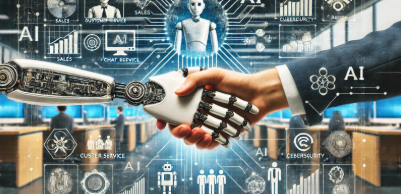
Nowadays, most of the things are being done with the help of AI, be it improving skills, learning skills, security etc. Currently, security teams are facing a shortage of skilled people due to which security leaders can try to fill the skill gap in the organization by using artificial intelligence.
According to a global survey, out of 1870 plus IT and cybersecurity experts from 29 countries, only 97% said that they are thinking about using AI-based cybersecurity and may do so.
The survey also revealed that 86% of organizations will face one or more security breaches in 2024 involving approx. 25% plus companies faced 5 or more attacks. Accordingly, these numbers have increased significantly compared to 2021.
All these incidents have been quite frequent and there are some financial impacts as well—52% organizations have said that they have suffered a significant loss due to this breach, approx. more than $1 million.
That is why most of the companies are relying more on AI-tools, but at the same time they are also worried that hackers might use AI tools to launch new powerful cyberattacks which could impact security.
Strengthen Your Digital Defense: Invest in Cyber Experts:
Approx. 80% of people have said that AI tools are helping out IT and cybersecurity teams, but it must also be acknowledged that AI tools alone cannot handle or strengthen security. According to the 2024 ISC2 Cybersecurity Workforce Study, there is still a shortage of more than 4.7 million cybersecurity professionals worldwide.
Fortinet’s CISO Carl Windsor said, this survey shows that we now have to take a big step which is “investing in cybersecurity talent”. If this is not done, both public and private sectors are at risk and later this will lead to huge expenses, security will be compromised and this will become a big challenge for the society.
Thomas Vick, technology hiring expert of Robert Half firm said, due to lack of qualified cybersecurity professionals, IT and cybersecurity teams are struggling to patch vulnerabilities, manage technical debt and protect against advance threats. These are the reasons why employers are offering high salaries and extra peaks to attract cyber experts.
They said that according to 2026 salary research, more than half of employees are willing to pay higher compensation if the candidate has cybersecurity or cloud security skills.
Mark St. John, co-founder of Neon Cyber, said that skilled professionals are very welcome to job-hop, but this causes significant losses to companies. Experienced employees who leave lose valuable knowledge and understanding of data sensitivity, which puts companies at high risk of breaches.

AI Expansion vs. Skills Gap: The Ongoing Challenge :
Currently, most organizations are considering or planning to use AI tools. But even in this, approx. Some companies say that the biggest reason and challenge for integrating AI into security is the lack of skilled staff.
Tim Freestone, Chief Strategy Officer at Kiteworks, said that there is a paradox that AI has been created and designed to improve security, but due to the lack of trained people, its potential has not been fully utilized.
They say that to properly deploy, manage, and optimize AI tools, a double skill set is required: on the one hand, one must be able to understand and handle AI systems, and on the other, one must be able to defend against AI-powered attacks. But both these skills are still very rare in the market.
According to Fortinet’s report, this skills gap is not only a technical issue but has also become a significant business risk. Every company is using AI tools, but the lack of in-house AI experts is widening the gap between technology and readiness.
Diana Kelley, CISO of Noma Security, said that new skills have emerged in the AI field—such as prompt engineering and AI agent coding—are in demand. But for every AI implementation, the CISO team must focus on AI security.
Upskilling Investments Essential for Cyber Growth :
The survey revealed and suggested that organizations should invest more in cybersecurity and employee development, but this time the willingness for certification payment has decreased from 89% to 73%. This raises concerns that companies should review their risk management strategy.
Lisa Simon, chief economist at Revelio Labs (New York), said that employees rely heavily on certification, especially in the healthcare, finance, and government sectors. Certification gives employees confidence. However, it also has some drawbacks, as it leads to the overlooking of candidates who have practical experience but lack certification. This also slows down the hiring process.
He said that companies should also focus on their training pipeline, certification is a good indicator but not the only filter.
Surveys suggest that the foundation of cyber risk management is skilled and aware employees. In this digital world, companies will have to remain constantly vigilant and maintain risk awareness so that they can protect their data systems.

AI Technology Behind 41% of Cyber Incidents in Schools
In countries like the UK and the US, 41% of schools reported cyber incidents caused by AI.





1 Comment
[…] Artificial Intelligence Security Teams :2025 […]